

PUCET (PG) 2027 is expected to be the entrance examination for admission to various M.Sc. programmes offered by Panjab University, Chandigarh. Based on the latest available examination pattern, the test is likely to consist of 75 multiple-choice questions to be completed in 90 minutes. Understanding the syllabus, exam pattern, and a structured preparation strategy can significantly improve your chances of securing admission.
What Is PUCET (PG) 2027 and Why Is It Important?
PUCET (PG) 2027 is expected to be the official entrance examination conducted by Panjab University, Chandigarh, for admission to postgraduate programmes, including various M.Sc. courses. Every year, thousands of science graduates compete for limited seats in departments such as Biotechnology, Life Sciences, Biochemistry, Microbiology, Botany, Zoology, Chemistry, Physics, and Mathematics.
A good score in the PU-CET (PG) not only helps students secure admission to one of India’s reputed public universities but also opens opportunities for research, higher education, teaching, and careers in biotechnology, pharmaceuticals, healthcare, environmental sciences, and academia.
Since competition is increasing every year, candidates should begin their preparation well in advance instead of waiting for the official notification.
Why Do So Many Students Choose Panjab University for an M.Sc.?
Panjab University has earned a strong reputation for its academic excellence, experienced faculty, and research-driven learning environment. Its postgraduate science programmes are recognised by universities, research organisations, and industries across India.
Some advantages of pursuing an M.Sc. from Panjab University include:
- Strong academic reputation
- Experienced faculty members
- Modern laboratories and research facilities
- Affordable education
- Opportunities for Ph.D. and research
- Better career prospects in industry and academia
- Exposure to seminars, workshops, and research projects
Whether your goal is to pursue research, qualify for competitive examinations such as CSIR NET, or build a career in biotechnology or life sciences, Panjab University provides an excellent academic platform.
Who Can Apply for the Panjab University M.Sc. Entrance Examination?
The official PU-CET (PG) 2027 admission brochure is awaited. Until then, candidates can refer to previous admission notifications to understand the expected eligibility requirements.
Generally, applicants should meet the following conditions:
Bachelor’s Degree
Candidates should possess a Bachelor’s degree (B.Sc. or equivalent) in the relevant discipline from a recognised university. The minimum qualifying marks vary depending on the programme and reservation category.
Final-Year Students
Students appearing in the final year or final semester of their undergraduate programme are generally eligible to apply provisionally. They must produce proof of passing the qualifying examination during the admission process.
Subject-Specific Eligibility
Each department specifies its own academic requirements. For example:
- Biotechnology may require Life Sciences or Biotechnology subjects.
- Microbiology programmes generally require Biology-related subjects.
- Chemistry applicants should have studied Chemistry during graduation.
- Mathematics programmes require Mathematics as a core subject.
Candidates should always verify programme-specific eligibility after the official admission notification is released.
When Is the PUCET (PG) 2027 Notification Expected?
The official schedule for PUCET 2027 has not yet been announced. Based on previous admission cycles, candidates can expect the notification and application process to begin around the middle of the year.
| Event | Expected Timeline* |
| Official Notification | Expected in 2027 |
| Online Application Begins | After notification |
| Admit Card Release | Before the examination |
| PUCET (PG) Examination | As announced by the university |
| Result Declaration | After the examination |
| Counselling & Admission | Following merit list publication |
*Note: These are only expected stages based on previous admission cycles. Candidates should rely on the official Panjab University notification for confirmed dates.
What Is the Expected PUCET (PG) 2027 Exam Pattern?
Based on the latest available Panjab University examination pattern, the entrance examination is expected to remain objective in nature. However, candidates should verify the final details after the official PU-CET (PG) 2027 prospectus is released.
| Exam Parameter | Expected Pattern |
| Examination Mode | Offline (OMR-Based) |
| Duration | 90 Minutes |
| Total Questions | 75 MCQs |
| Question Type | Objective (Multiple Choice Questions) |
| Maximum Marks | 75 Marks |
| Medium | English |
| Syllabus | Subject-specific undergraduate syllabus |
A clear understanding of the exam pattern helps candidates plan their preparation more effectively and allocate time according to the weightage of different topics.
Is the PUCET (PG) Exam Difficult?
The difficulty level of PU-CET (PG) is generally considered moderate to challenging, depending on the subject and the candidate’s preparation.
The examination primarily tests:
- Conceptual understanding
- Subject fundamentals
- Analytical thinking
- Scientific reasoning
- Problem-solving ability
- Speed and accuracy
Students who consistently revise undergraduate concepts and solve previous-year papers usually perform much better than those relying on last-minute preparation.
Why Should Students Start Preparing Early?
Many aspirants begin preparing only after the official notification is released. However, this often leaves limited time to revise the entire syllabus.
Starting preparation early offers several advantages:
- Enough time to complete the syllabus thoroughly
- Better conceptual understanding
- Multiple rounds of revision
- More practice through mock tests
- Improved time management skills
- Reduced examination stress
Students who prefer a structured preparation plan often benefit from expert guidance, regular classroom sessions, and scheduled mock tests. Institutes such as Biotech Sapiens, located at SCO 215, Sector 37-C, 2nd Floor, Chandigarh, support aspirants through organised study plans, subject-wise mentoring, and exam-oriented practice while encouraging consistent self-study.
How Can Biotech Sapiens Help Students Prepare from the Beginning?
Beginning preparation with the right guidance can make the journey more organised and less overwhelming. Along with self-study, many aspirants choose structured classroom programmes to maintain consistency and track their progress.
At Biotech Sapiens, students preparing for the Panjab University M.Sc. entrance receive support through experienced faculty, small batch sizes, regular classroom teaching, doubt-clearing sessions, and topic-wise practice. The institute also encourages students to build strong fundamentals before moving on to advanced problem-solving and mock tests.
Students interested in learning more about classroom programmes, study material, and preparation support can explore https://biotechsapiens.com/ for updated course information.
How Are PUCET (PG) Cutoffs Determined Every Year?
The PUCET (PG) cutoff is the minimum score or merit level required for admission to a specific M.Sc. programme at Panjab University. Since each department has a different number of seats and applicant pool, there is no fixed cutoff for PUCET (PG). Candidates should avoid relying on unofficial cutoff predictions and instead aim to maximise their entrance score. Admission is ultimately based on the university’s merit process and departmental criteria.
Several factors influence the cutoff every year:
- Number of applicants: More applicants generally increase competition.
- Difficulty level: A tougher paper often results in lower average scores, while an easier paper may raise cutoffs.
- Seat availability: Departments with fewer seats usually have higher competition.
- Reservation policy: Different categories have separate merit lists according to university rules.
- Overall performance: The collective performance of candidates in a particular subject also affects the final cutoff.
Rather than targeting an expected cutoff, students should prepare to score as high as possible to improve their chances of securing admission to their preferred department.
Which Subjects and Topics Should Students Prioritise During Preparation?
The PU-CET (PG) syllabus is based on the undergraduate curriculum relevant to the programme selected by the candidate. As the official PUCET (PG) 2027 syllabus is awaited, students should refer to the latest syllabus issued by Panjab University for their chosen subject and verify any updates once the new admission brochure is released.
For Biotechnology, Life Sciences, Botany, Zoology & Microbiology
Focus on building strong conceptual knowledge in:
- Cell Biology
- Molecular Biology
- Genetics
- Biochemistry
- Immunology
- Microbiology
- Recombinant DNA Technology
- Plant Physiology
- Animal Physiology
- Ecology
- Evolution
For Chemistry
Important topics include:
- Physical Chemistry
- Organic Reaction Mechanisms
- Inorganic Chemistry
- Thermodynamics
- Chemical Kinetics
- Coordination Chemistry
- Spectroscopy
For Physics
Give special attention to:
- Classical Mechanics
- Quantum Mechanics
- Electromagnetism
- Electronics
- Nuclear Physics
- Optics
For Mathematics
Key areas include:
- Linear Algebra
- Differential Equations
- Real Analysis
- Complex Analysis
- Probability
- Vector Calculus
Instead of trying to study every available resource, master your university-level textbooks first and then strengthen your preparation through objective practice.
How Can Students Create an Effective Preparation Strategy?
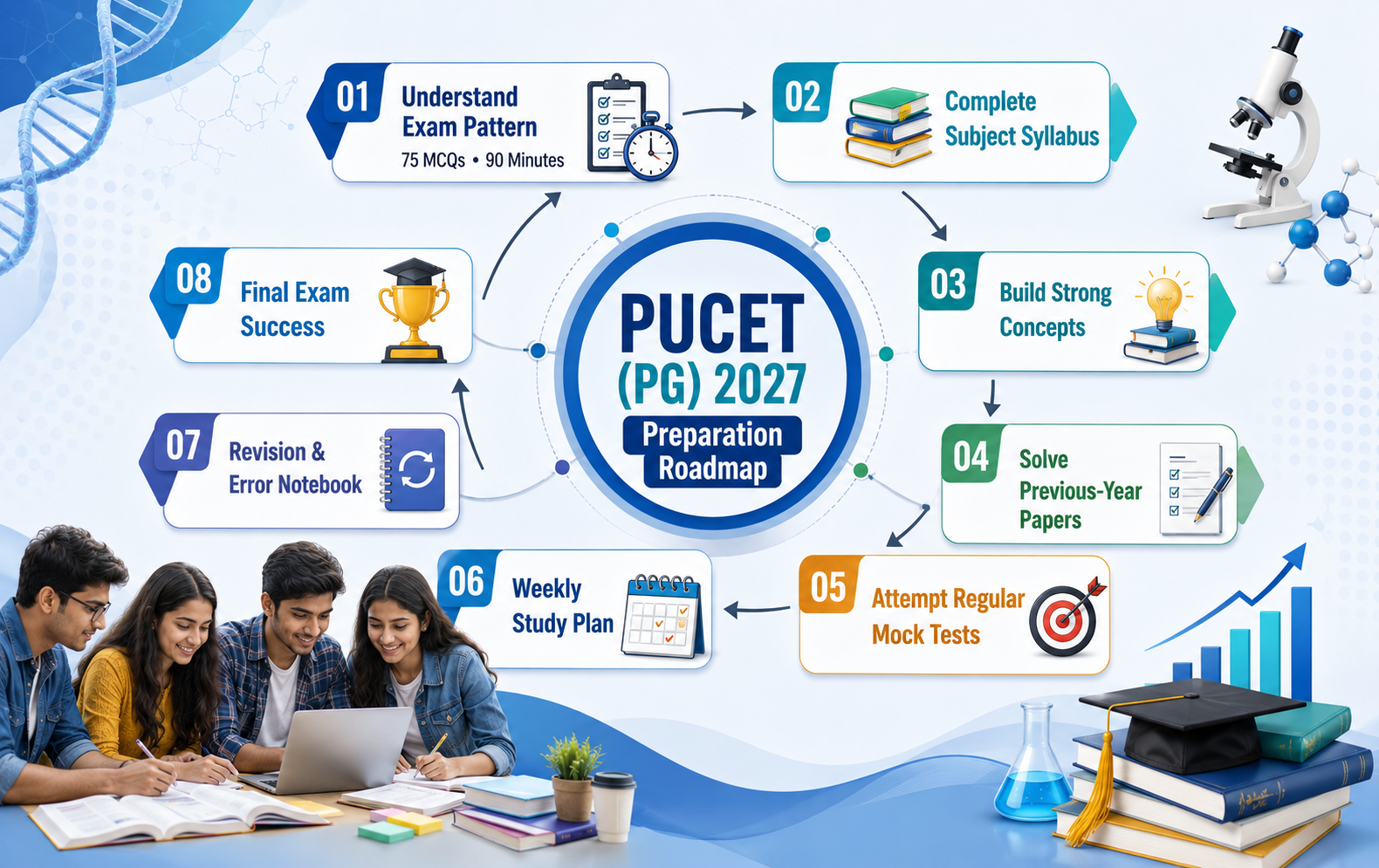
Preparing for PUCET 2027 requires consistency rather than last-minute studying. A structured approach helps students cover the syllabus systematically while leaving enough time for revision and practice.
An effective preparation strategy should include:
1. Divide the Syllabus into Weekly Goals
Break the syllabus into smaller sections and assign realistic weekly targets. Completing manageable portions consistently is more effective than studying randomly.
2. Strengthen Fundamental Concepts
Most questions test conceptual understanding rather than memorisation. Spend sufficient time revising undergraduate notes and standard textbooks before attempting objective questions.
3. Solve Previous-Year Question Papers
Practising previous-year papers helps you understand:
- Frequently asked topics
- Question trends
- Difficulty level
- Time management
- Exam temperament
Many students preparing with Biotech Sapiens receive topic-wise practice questions and guided discussions on previous-year papers, helping them identify recurring concepts more efficiently.
4. Attempt Regular Mock Tests
Mock tests simulate the actual examination environment and help improve:
- Accuracy
- Speed
- Time management
- Confidence
Students enrolled in PUCET COACHING programmes often benefit from scheduled mock tests and detailed performance analysis, making it easier to track progress throughout their preparation.
5. Maintain an Error Notebook
After every mock test, note down:
- Incorrect answers
- Frequently forgotten facts
- Important formulas
- Difficult concepts
Revisiting these mistakes regularly prevents repeating them in the actual examination.
6. Follow a Healthy Study Routine
A balanced routine is equally important. Take short breaks, maintain regular sleep, and revise consistently instead of studying for excessively long hours without focus.
How Can Students Prepare for PUCET (PG) in Six Months?
A six-month preparation plan gives candidates enough time to complete the syllabus, revise important topics, and practise extensively.
| Month | Focus Area | Recommended Activities |
| Month 1 | Understand the syllabus | Collect study material, revise undergraduate fundamentals, and prepare a study schedule. |
| Month 2 | Build core concepts | Complete high-weightage topics and solve chapter-wise MCQs. |
| Month 3 | Cover advanced topics | Finish the remaining syllabus and begin weekly revision. |
| Month 4 | Practice phase | Solve PUCET previous year papers, analyse mistakes, and improve accuracy. |
| Month 5 | Mock test phase | Attempt full-length mock tests, improve speed, and work on weak areas. |
| Month 6 | Final revision | Revise notes, formulas, diagrams, and your error notebook while taking a few final mock tests. |
Students who prefer a more organised approach often combine self-study with PU M.Sc entrance coaching, where experienced faculty help maintain a disciplined preparation schedule and provide regular feedback.
Why Are Previous-Year Papers and Mock Tests So Important?
Many successful candidates consider previous-year papers and mock tests among the most valuable preparation tools.
They help students:
- Understand exam trends
- Improve time management
- Identify frequently tested topics
- Build confidence before the examination
- Reduce exam-day anxiety
At Biotech Sapiens, students receive access to subject-wise practice material, regular mock examinations, and personalised performance reviews. This structured approach enables aspirants to recognise weak areas early and refine their preparation before the final examination.
Is Coaching Necessary for PUCET (PG) Preparation?
Coaching is not compulsory to qualify for the Panjab University M.Sc. Entrance Examination. Many students successfully secure admission through disciplined self-study.
However, PUCET COACHING can be beneficial for candidates who need:
- A structured study plan
- Expert faculty guidance
- Regular classroom learning
- Doubt-clearing sessions
- Previous-year paper discussions
- Weekly assessments
- Mock tests with performance analysis
- Personal mentoring
For students looking for PU M.Sc entrance coaching, a structured programme can help maintain consistency and improve preparation quality. Institutions such as Biotech Sapiens support aspirants through classroom teaching, topic-wise practice, and continuous academic guidance while encouraging independent learning.
Why Do Many Students Choose Biotech Sapiens for PU M.Sc. Entrance Preparation?
Preparing for the Panjab University M.Sc. Entrance Examination requires more than just completing the syllabus. Students also need expert guidance, consistent practice, regular assessment, and a disciplined study routine. This is why many aspirants choose structured coaching to complement their self-study.
Biotech Sapiens, located at SCO 215, Sector 37-C, 2nd Floor, Chandigarh, focuses on postgraduate life science entrance preparation. The institute offers classroom programmes designed for students preparing for PU-CET (PG) and other M.Sc. entrance examinations.
Students preparing with Biotech Sapiens benefit from:
- Experienced faculty with subject expertise
- Small batch sizes for personalised attention
- Comprehensive coverage of the syllabus
- Regular classroom lectures
- Topic-wise MCQ practice
- Previous-year paper discussions
- Weekly assessments and full-length mock tests
- Doubt-clearing sessions
- Performance tracking and individual feedback
- Affordable fee structure
The institute provides guidance for students preparing in disciplines such as Biotechnology, Life Sciences, Biochemistry, Microbiology, Botany, Zoology, and other related postgraduate entrance examinations.
Students interested in structured PU M.Sc entrance coaching can explore the classroom programmes, study material, and upcoming batches available through Biotech Sapiens.
What Are the Most Frequently Asked Questions About PUCET (PG) 2027?
What is PUCET (PG)?
PUCET (PG) is the Panjab University Common Entrance Test (Postgraduate) conducted for admission to various postgraduate programmes, including M.Sc. courses offered by Panjab University, Chandigarh. The examination evaluates candidates on subject-specific knowledge gained during their undergraduate studies.
Who can apply for the Panjab University M.Sc. Entrance Examination?
Candidates with a recognised Bachelor’s degree in the relevant discipline are generally eligible to apply. Students appearing in the final year of their undergraduate programme may also apply provisionally, subject to fulfilling the eligibility requirements during admission. Candidates should verify the official admission brochure for programme-specific criteria.
What is the expected PUCET (PG) 2027 exam pattern?
Based on the latest available Panjab University examination pattern, the entrance test is expected to be conducted in offline (OMR-based) mode with 75 multiple-choice questions to be completed within 90 minutes. Candidates should verify the official PU-CET (PG) 2027 prospectus once it is released for any updates.
How are PUCET (PG) cutoffs decided?
PUCET (PG) cutoffs vary every year depending on factors such as the number of applicants, examination difficulty, seat availability, reservation category, and the overall performance of candidates. Since these factors change annually, students should focus on maximising their score rather than relying on expected cutoff predictions.
How many months are enough for PUCET (PG) preparation?
A preparation period of four to six months is generally sufficient for most students if they follow a disciplined study plan. Consistent revision, solving previous-year papers, attempting mock tests, and regularly analysing mistakes are key to effective preparation.
Is coaching necessary for PUCET (PG)?
Coaching is not mandatory, but it can provide structured learning, expert mentoring, mock tests, and regular performance analysis. Many students combine self-study with PUCET COACHING to maintain consistency, improve time management, and receive guidance on difficult topics.
Can final-year B.Sc. students apply for PUCET (PG)?
Yes. Final-year undergraduate students are generally eligible to apply provisionally, provided they meet the university’s eligibility requirements and submit proof of passing the qualifying examination during the admission process.
How important are previous-year papers and mock tests?
Previous-year papers help candidates understand the examination pattern, identify frequently tested topics, and improve time management. Mock tests simulate the actual exam environment, helping students evaluate their preparation level and build confidence before the final examination.
What Should Be Your Next Steps to Ace the Panjab University M.Sc. Entrance?
Success in PUCET (PG) 2027 begins with a clear understanding of the examination pattern, syllabus, and admission process. Instead of waiting for the official notification, start strengthening your undergraduate concepts, create a realistic study schedule, solve previous-year papers, and take regular mock tests. Consistent revision and performance analysis can make a significant difference in your final score.
If you’re looking for a more structured approach, Biotech Sapiens offers guidance through experienced faculty, classroom learning, doubt-clearing sessions, mock tests, and performance tracking for postgraduate entrance aspirants. Whether you’re preparing for Biotechnology, Life Sciences, Biochemistry, Microbiology, Botany, Zoology, or other M.Sc. programmes, structured support can complement your self-study and keep you on track.
Explore the PU M.Sc. entrance coaching programmes, study resources, and upcoming classroom batches at Biotech Sapiens, and begin your preparation with confidence toward securing admission to your preferred M.Sc. programme at Panjab University, Chandigarh.