

GATE Biotechnology 2027 is a national-level entrance exam conducted by an IIT or IISc Bangalore for admission into M.Tech., Ph.D., and PSU recruitment. Based on the latest available GATE Biotechnology examination pattern, the 100-mark paper contains General Aptitude (15%), Engineering Mathematics (13%), and Core Biotechnology subjects (72%). A structured 6-month study plan maximizes speed, accuracy, and conceptual depth.
What Is GATE Biotechnology 2027 and Why Is It Important?
Organized by the Indian Institutes of Technology (IITs) alongside IISc Bangalore, GATE Biotechnology 2027 stands as the premier Graduate Aptitude Test in Engineering for biotech students across India. Securing a strong score opens doors to M.Tech., M.E., and Ph.D. degrees at top universities, complete with monthly MHRD/MoE financial stipends.
Beyond postgraduate studies, a solid rank lets you apply directly for jobs at major Public Sector Undertakings (PSUs) and national research labs. Private research teams in biopharmaceuticals, agricultural technology, and industrial microbiology also view a GATE qualification as clear proof that you know your stuff.
Who Can Apply for GATE Biotechnology 2027?
If you hold an undergraduate degree in engineering, technology, architecture, or science—or if you’re currently in your final year—you can apply. This includes students wrapping up B.Tech (Biotechnology) degrees or B.Sc./M.Sc. programs in fields like Life Sciences, Biochemistry, Microbiology, and Molecular Biology.
There is no maximum age limit for test takers. Since the official GATE 2027 brochure is awaited, candidates should verify the final details after the official notification is released.
What Is the Expected GATE Biotechnology 2027 Exam Pattern?
Based on the latest available GATE Biotechnology examination pattern, the test takes place as a 3-hour Computer-Based Test (CBT) evaluated out of 100 total marks. Questions come in three distinct formats: Multiple Choice Questions (MCQs), Multiple Select Questions (MSQs), and Numerical Answer Type (NAT) problems.
| Parameter | Details |
| Exam Mode | Computer-Based Test (CBT) |
| Duration | 3 Hours (180 Minutes) |
| Total Questions | 65 |
| Total Marks | 100 |
| Question Types | MCQs (1 or 2 marks), MSQs (1 or 2 marks), NATs (1 or 2 marks) |
| Negative Marking | 1/3 mark for 1-mark MCQs; 2/3 mark for 2-mark MCQs. No negative marking for MSQs and NATs. |
| General Aptitude | 15 Marks |
| Engineering Mathematics | ~13 Marks |
| Core Biotechnology | ~72 Marks |
Candidates should verify the final details after the official notification is released.
How Much Weight Does Each Section Carry in GATE Biotechnology?
The question paper breaks down into three distinct subjects: General Aptitude, Engineering Mathematics, and Core Biotechnology. Keeping these weightages in mind helps you split your daily study hours wisely instead of spending weeks on low-value topics.
| Section | Approximate Weightage (%) | Total Marks |
| General Aptitude | 15% | 15 Marks |
| Engineering Mathematics | ~13% | ~13 Marks |
| Core Biotechnology | ~72% | ~72 Marks |
Note: These percentages are based on the latest available examination pattern and past paper trends.
Which Biotechnology Subjects Usually Carry the Highest Weightage?
While the GATE BT syllabus touches on many sub-fields, a few core areas consistently yield the bulk of the technical marks. While topic distribution shifts every year, mastering these key subjects ensures you build a strong foundation for a high score.
- Bioprocess Engineering & Process Biotechnology: This area usually carries heavy weight and brings plenty of NAT questions on bioreactor design, stoichiometry, and reaction kinetics.
- Recombinant DNA Technology & Molecular Biology: Focuses on gene cloning methods, expression vectors, and molecular processes like replication, transcription, and translation.
- Biochemistry & Microbiology: Fundamental subjects where you’ll face questions on metabolic pathways, enzyme kinetics, and microbial growth rates.
- Genetics, Cell Biology & Immunology: Covers inheritance patterns, cell signaling pathways, antigen-antibody interactions, and monoclonal antibody production.
- Plant & Animal Biotechnology: Focuses on tissue culture techniques, transgenic methods, and vector systems used in plant and animal systems.
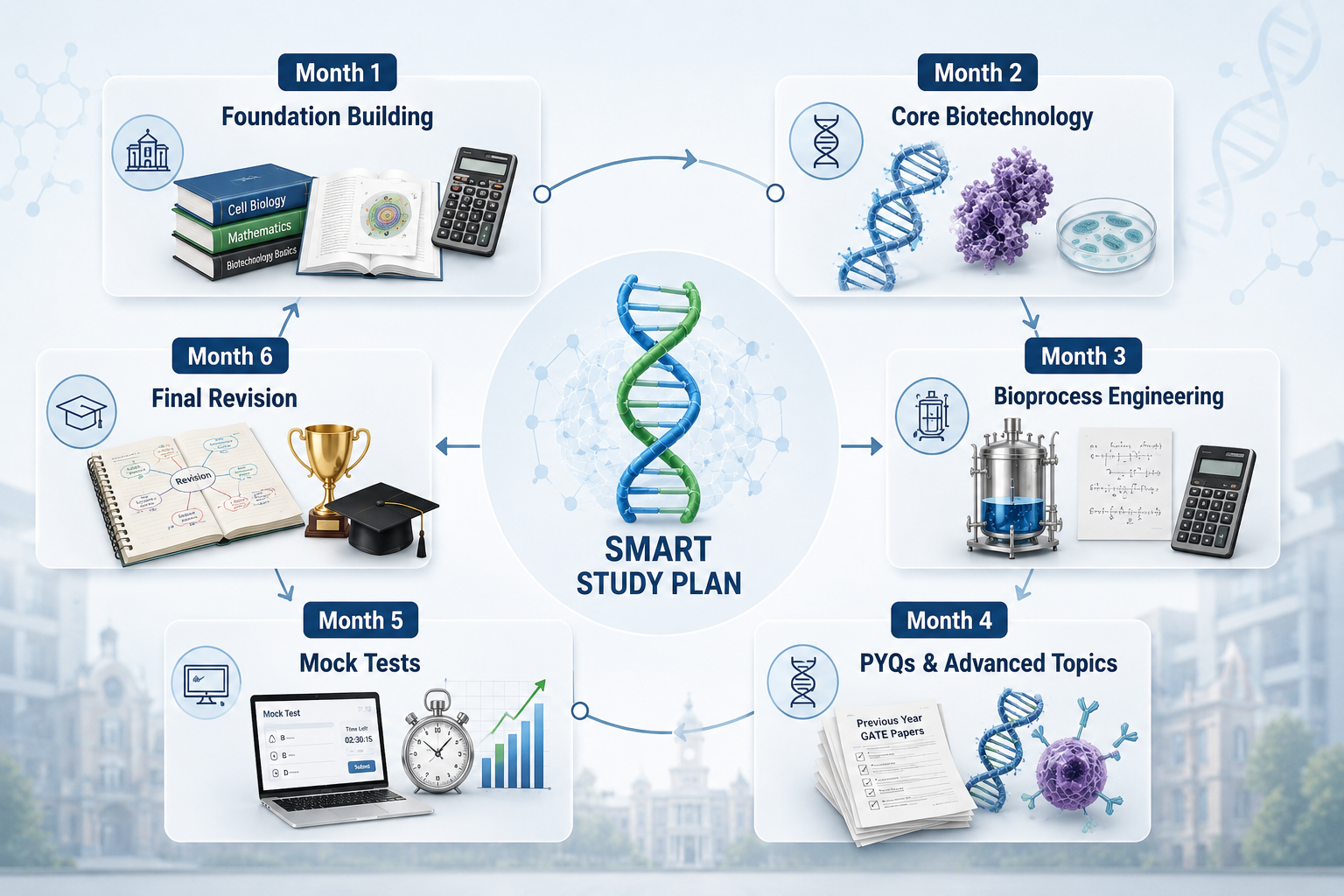
How Can Students Build a Smart 6-Month Study Plan?
Breaking six months into focused, bite-sized phases keeps your routine productive without burnout. Anchoring your gate biotechnology preparation around core concepts, calculation drills, and mock testing builds steady momentum all the way to exam day.
| Timeline | Primary Focus | Key Action Items |
| Month 1 | Foundations & Math | Work through Engineering Mathematics, General Aptitude, Biochemistry, and fundamental Cell Biology. |
| Month 2 | Core Biotech | Tackle Molecular Biology, Recombinant DNA Technology, and core Microbiology. |
| Month 3 | Advanced Calculations | Shift gears into Bioprocess Engineering, Enzyme Kinetics, and process stoichiometry problems. |
| Month 4 | Specialized Topics & PYQs | Study Genetics, Immunology, and Plant/Animal Biotech; complete 10 years of past GATE BT papers. |
| Month 5 | Mock Tests & Timing | Take two full-length mock tests a week; review wrong answers carefully and plug knowledge gaps. |
| Month 6 | Final Revision | Review short notes, mind maps, and formula sheets; avoid starting completely new topics now. |
Which Resources Should Students Use During GATE Biotechnology Preparation?
Scoring at the top requires sticking to reliable textbooks and proven practice materials:
- Standard Textbooks: Keep books like Bioprocess Engineering Principles by Pauline Doran, Lehninger Principles of Biochemistry, Microbiology by Prescott, and Molecular Biology of the Cell by Alberts close at hand.
- Mathematics & Aptitude: Use Higher Engineering Mathematics by B.S. Grewal alongside standard competitive aptitude workbooks.
- Previous Year Papers: Working through 10 to 15 years of actual GATE BT papers helps you internalize how questions are asked and how tricky the numericals get.
- Formula Sheets & Quick Notes: Write down bioprocess formulas, mathematical equations, and metabolic pathways in a dedicated notebook so you can review them quickly right before the test.
What Common Mistakes Reduce GATE Biotechnology Scores?
- Skipping Engineering Mathematics: Students often leave math for last, effectively giving away up to 13 straightforward marks that often separate top rankers from the rest.
- Ignoring General Aptitude: Aptitude offers 15 relatively easy marks; brushing it off costs you valuable points on your final score.
- Avoiding Bioprocess Numericals: Skipping numerical practice out of fear leaves you empty-handed on high-yield NAT questions.
- Reading Theory Without Solving PYQs: Memorizing textbooks without working through past questions leaves you unprepared for how concepts are actually tested.
- Guessing blindly on MSQs: Multiple Select Questions don’t carry negative marks, but missing even one correct option means zero points. You need crystal-clear concepts to mark them correctly.
Is Coaching Necessary for GATE Biotechnology Preparation?
While self-study can work well if you are disciplined, joining a structured GATE BIOTECH COACHING program helps keep your schedule on track. It takes the guesswork out of difficult topics like Bioprocess Engineering and offers regular mock exams that mirror the real test environment.
A guided GATE Biotechnology preparation course gives you curated material, expert assistance when you run into tough concepts, and continuous feedback, saving you countless hours of trying to figure everything out on your own.
Why Can Students Consider Biotech Sapiens for GATE Biotechnology Preparation?
If you are looking for structured guidance, Biotech Sapiens offers tailored programs built specifically for Biotechnology and Life Sciences students. Located at SCO 215, Sector 37-C, Chandigarh, the center runs regular classroom coaching alongside interactive online classes.
Students getting ready for upcoming GATE attempts can count on:
- Faculty members who specialize in core GATE BT subjects and bioprocess numericals.
- Smaller batch sizes so you can ask questions directly and get personal attention.
- Complete syllabus coverage across General Aptitude, Mathematics, and Core Biotechnology.
- Regular unit tests, practice exams, and clear performance feedback.
Students looking for a reliable, step-by-step strategy can check out the GATE BIOTECH COACHING options at Biotech Sapiens to strengthen their core concepts and approach the exam with confidence.
Sure — here is the same responsive, black-and-white accordion with all CSS inline, using no JavaScript.
Frequently Asked Questions About GATE Biotechnology
What is GATE Biotechnology?
+
life sciences students. Clearing it allows you to apply for master’s
and Ph.D. programs at IITs, IISc, and NITs, or qualify for recruitment
at select PSUs.
What is the latest GATE Biotechnology exam pattern?
+
carries 100 total marks across 65 questions. It covers General Aptitude
(15 marks), Engineering Mathematics (~13 marks), and Core Biotechnology
(~72 marks), using MCQs, MSQs, and NATs.
Is Engineering Mathematics compulsory for GATE BT?
+
It accounts for about 13% of the total score and plays a big role in
securing a top rank.
How many months are enough for GATE Biotechnology preparation?
+
usually enough time to cover the syllabus, work through past papers,
and complete full-length mock tests.
Can Life Sciences or Microbiology students apply for GATE BT?
+
Microbiology, Biochemistry, Molecular Biology, or related fields are
fully eligible to sit for the GATE Biotechnology exam.
How important are previous year papers for GATE BT?
+
most often, helps you get comfortable with bioprocess calculations,
and builds your test-taking speed.
Which section carries the highest weightage in GATE BT?
+
for roughly 72% (72 marks) of the total exam score.
Note: Because this uses only inline CSS and no JavaScript, the + icon won’t automatically change to − when opened. The accordion itself will still work perfectly.
How Should Aspirants Approach Their Final Preparation Strategy?
Succeeding in GATE Biotechnology 2027 comes down to building strong core concepts and staying sharp with numerical calculations in bioprocess engineering. Knowing where the marks lie allows you to spend your time where it matters most. Keep up a steady daily routine, practice past question papers until the formats feel second nature, and use mock tests to fine-tune your timing. If you want structured support and experienced guidance along the way, learning with established mentors at Biotech Sapiens can help keep your preparation focused and on track. Start early, stay consistent, and take on the exam with a clear plan.