

So, you’ve decided to pursue a Master’s degree. Whether you’re dreaming of the prestigious labs of the IITs, the sprawling research wings of DU and BHU, or the cutting-edge facilities at Panjab University right here in Chandigarh, one thing is certain: moving from a BSc to an MSc is a massive gear shift.
Every year, thousands of students across India sit for these exams, but only a small fraction make it into the top-tier institutes. If you’re feeling overwhelmed by a syllabus that seems to never end, or you’re wondering if three to six months is actually enough time to catch up, take a deep breath. You aren’t alone. Most students struggle not because they lack the brainpower, but because they lack a battle-tested roadmap.
In this guide, we are going to strip away the fluff and look at the exact MSc entrance exam preparation strategy you need to move from “confused” to “confident,” with a specific focus on the unique competitive landscape for students in the Chandigarh region.
The Landscape: Understanding MSc Entrance Exams in India
Before you start burying your head in textbooks, you need to know exactly which “battle” you are fighting. In India, the MSc entrance ecosystem is quite diverse. Depending on whether your passion lies in Biotechnology, Zoology, Botany, or Microbiology, the exams vary in flavor and difficulty.
- IIT JAM (Joint Admission Test for Masters): This is the gold standard. Cracking this opens the doors to IITs and NITs. An IIT JAM preparation strategy requires a deep, intuitive understanding of concepts rather than just memorizing facts.
- GAT-B (Graduate Aptitude Test-Biotechnology): Essential for anyone eyeing top-tier Biotechnology and allied science programs across the country.
- CUET-PG: This has recently become a massive gateway for Central Universities like DU, BHU, and JNU.
- PU-CET (PG): For us in Chandigarh, this is the big one. Getting into Panjab University is incredibly competitive because of its stellar reputation in the life sciences.
- JGEEBILS: This is the one for students leaning toward high-end biological research at places like TIFR and NCBS.
Why Chandigarh Students Need a Smart Strategy
Chandigarh is often called the “Education Hub of North India.” Because we have a high concentration of brilliant minds from Punjab, Haryana, Himachal, and J&K all converging here, the competition is naturally fierce.
Being a student in Chandigarh is a double-edged sword. You have access to some of the best resources in the country, but the cutoff scores for local institutions like PU are sky-high. A “smart strategy” means you aren’t just studying hard—you are studying better than the person sitting next to you in the library. You need a plan that balances your final year BSc practicals and exams with the specialized, objective-style requirements of national-level entrances.
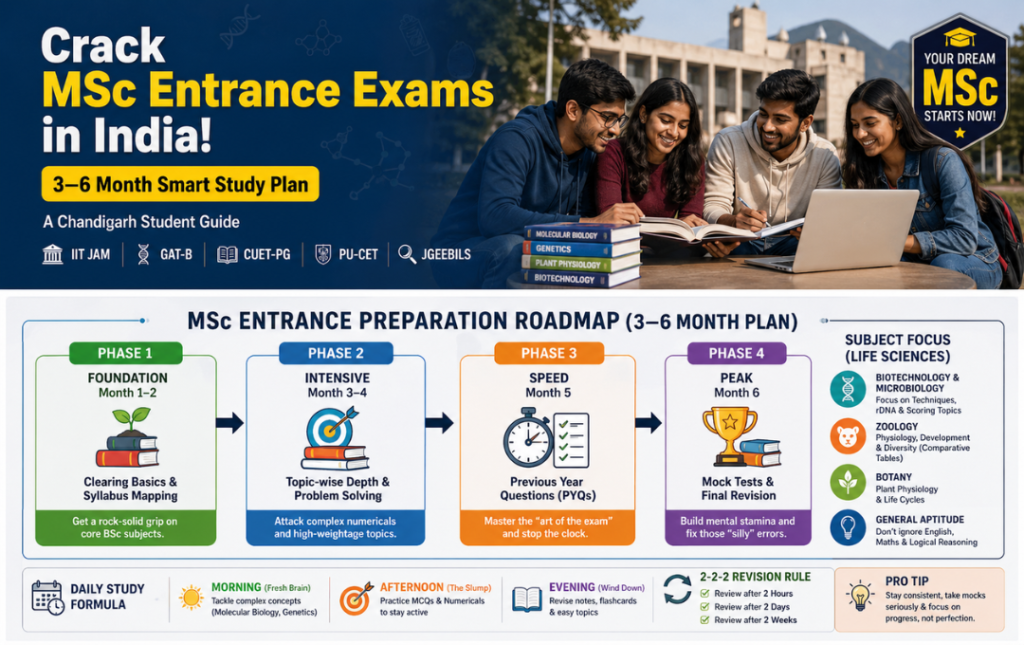
The 3–6 Month Master Study Plan
Can you crack a national exam in 3 months? Yes, it’s been done many times. Is 6 months better? Absolutely, because it gives your brain time to actually absorb the information. Below is a strategic breakdown of how to allocate your time.
MSc Entrance Preparation Timeline
| Phase | Duration | Focus Area | Ultimate Goal |
| Phase 1: Foundation | Month 1–2 | Clearing Basics & Syllabus Mapping | Get a rock-solid grip on core BSc subjects. |
| Phase 2: Intensive | Month 3–4 | Topic-wise Depth & Problem Solving | Attack complex numericals and high-weightage topics. |
| Phase 3: Speed | Month 5 | Previous Year Questions (PYQs) | Master the “art of the exam” and stop the clock. |
| Phase 4: Peak | Month 6 | Mock Tests & Final Revision | Build mental stamina and fix those “silly” errors. |
The 3 Month Study Plan for MSc Entrance (The Fast-Track)
If you only have 90 days left on the calendar, your 3-month study plan for MSc entrance must be surgical and high-impact:
- Week 1-4: Focus exclusively on high-weightage units. For Biology students, this usually means prioritizing Genetics, Molecular Biology, and Biochemistry.
- Week 5-8: Start solving MCQs every single day. Don’t just look for the right answer; look at the other three options and understand why they are wrong. That’s how you truly learn.
- Week 9-12: Transition to full-length mock tests. This is where you build the “sitting tolerance” required to stay sharp during a 3-hour exam.
Subject-Wise Preparation Tips (Life Sciences Focus)
If you are aiming for Botany, Zoology, or Biotechnology, the syllabus can feel like an ocean. Here is how to navigate it without drowning:
1. Biotechnology & Microbiology
Focus heavily on Techniques—things like Chromatography, Electrophoresis, and PCR—and rDNA technology. These are the “scoring” sections where questions are predictable. Don’t ignore Mathematics and Physics entirely; often, the basic 10+2 level questions in these sections are exactly what create the rank difference in GAT-B or IIT JAM.
2. Zoology
Animal Physiology and Developmental Biology should be your best friends. Create comparative tables for different phyla in Diversity of Life. It’s much easier to remember the nuances of an Annelid versus an Arthropod when they are side-by-side on a single sheet of paper.
3. Botany
Plant Physiology (Photosynthesis, Respiration, Phytohormones) is absolutely critical. For Diversity, focus on life cycles. A common mistake students make is skipping Taxonomy because it feels “dry”—don’t do it. Modern exams are bringing back classical Botany questions to test true subject depth.
Common Mistakes to Avoid
Even the brightest students can fail if they fall into these common traps:
- Ignoring the Specific Syllabus: Every exam is slightly different. Don’t study “everything.” Stick to the prescribed syllabus of the specific exam you are targeting.
- Neglecting General Aptitude: Exams like CUET and GAT-B have sections on English, Logic, and Basic Math. These are “low-hanging fruits” that can significantly boost your overall percentile.
- Over-reliance on Theory: You might know the Krebs cycle by heart, but if you can’t apply that knowledge to a “what if” experimental question, you’ll struggle.
- Skipping Mock Tests because of Fear: Many students avoid mocks because they are afraid of a low score. Remember: it’s much better to fail in a practice test in your room than in the actual exam hall.
Time Management & Revision Strategy
Your brain isn’t a hard drive; it’s more like a leaky bucket. To stop the information from leaking out, use the 2-2-2 Revision Rule:
- Review what you learned today after 2 hours.
- Review it again after 2 days.
- Review it once more after 2 weeks.
Daily Schedule Tip:
Try dividing your day into three distinct sessions:
- Morning (Fresh Brain): Tackle the complex concepts like Molecular Biology or Genetics.
- Afternoon (The Slump): Use this time for active tasks like practicing MCQs or solving Numericals to stay awake and engaged.
- Evening (Wind Down): Review easier topics or skim through your short notes and flashcards.
Why Professional Guidance Matters: Biotech Sapiens
While self-study is great, that extra competitive edge often comes from knowing the “hacks” and shortcuts that only experienced educators can provide. This is where Biotech Sapiens comes into the picture.
Widely recognized as India’s No.1 MSc Entrance Coaching in Chandigarh, Biotech Sapiens has built a massive reputation by consistently producing toppers in IIT JAM, GAT-B, and PU-CET.
Why Choose Biotech Sapiens?
- Expert Faculty: You’ll learn from educators who have actually cleared these exams and understand the changing patterns of the questions.
- Comprehensive Coverage: Whether your focus is Botany, Zoology, Biotechnology, or Microbiology, the curriculum is designed to take you from the basics to the advanced level.
- Updated Material: The world of science moves fast, and so do the exams. You get access to the most recent syllabus-based study material and rigorous test series.
- Proven Results: Their track record isn’t just talk; they have a high success rate of students getting into India’s premier research institutes year after year.
MSc coaching in Chandigarh is everywhere, but Biotech Sapiens stands out because of its personalized, student-first approach. They don’t just give you notes; they mentor you through the inevitable stress of exam season.
Pro Tip: If you’re serious about cracking your MSc entrance exam on the very first attempt, joining expert coaching like Biotech Sapiens can make a world of difference. Having a structured environment keeps you disciplined, which is usually the hardest part of the whole process.
FAQ Section
1. How to prepare for IIT JAM in 3 months?
Focus on the 70/30 rule. Identify the 30% of the syllabus that accounts for 70% of the marks in previous years. Prioritize Biology and Chemistry, and spend your final 30 days doing nothing but PYQs and Mock Tests.
2. Which MSc entrance exam is easiest in India?
“Easy” is a relative term, but many students find university-specific exams (like those for state universities) to be more straightforward than IIT JAM or GAT-B, which involve heavy conceptual application and negative marking.
3. Is coaching necessary for MSc entrance exams?
It’s not “mandatory,” but it provides a massive shortcut. Coaching offers a structured path, removes the guesswork of what’s important, and surrounds you with competitive peers. In a high-stakes environment like Chandigarh, it gives you a distinct advantage.
4. What is the best study plan for the MSc entrance?
A balanced 6-month plan is usually the “sweet spot.” Use 3 months for deep concept building, 2 months for intensive practice, and 1 final month for pure revision and daily mocks.
5. How many hours should I study daily?
Focus on quality over quantity. 5–6 hours of deep, distraction-free study (no phones!) is infinitely more effective than 10 hours of “passive” reading while daydreaming.
Conclusion
Cracking an MSc entrance exam is much more of a marathon than a sprint. It takes a mix of old-fashioned hard work, a solid 3-6 month strategy, and knowing when to ask for help. For students living in or around Chandigarh, you have a golden opportunity to leverage the best resources in the country.
Start today by mapping out your specific syllabus. Break it down into small, bite-sized goals that don’t feel impossible. Stay consistent, don’t let one bad practice score get you down, and remember that every expert was once a beginner who just refused to give up.
If you feel like you need that extra bit of direction and discipline, reach out to the team at Biotech Sapiens. With the right mentorship and your own dedication, that seat in your dream university isn’t just a wish—it’s a goal within your reach.
Ready to start? Your career in science starts with the very next page you turn!