
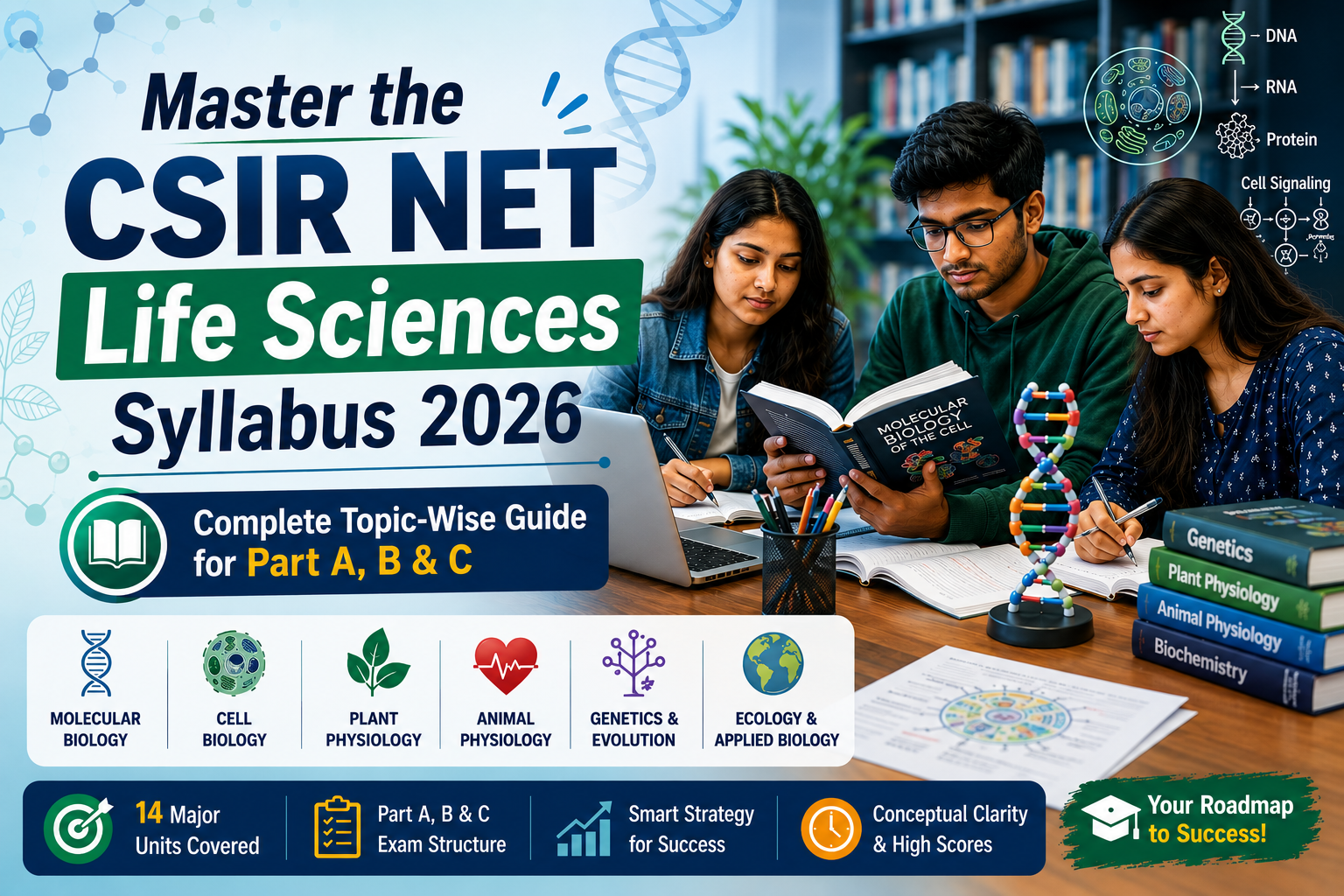
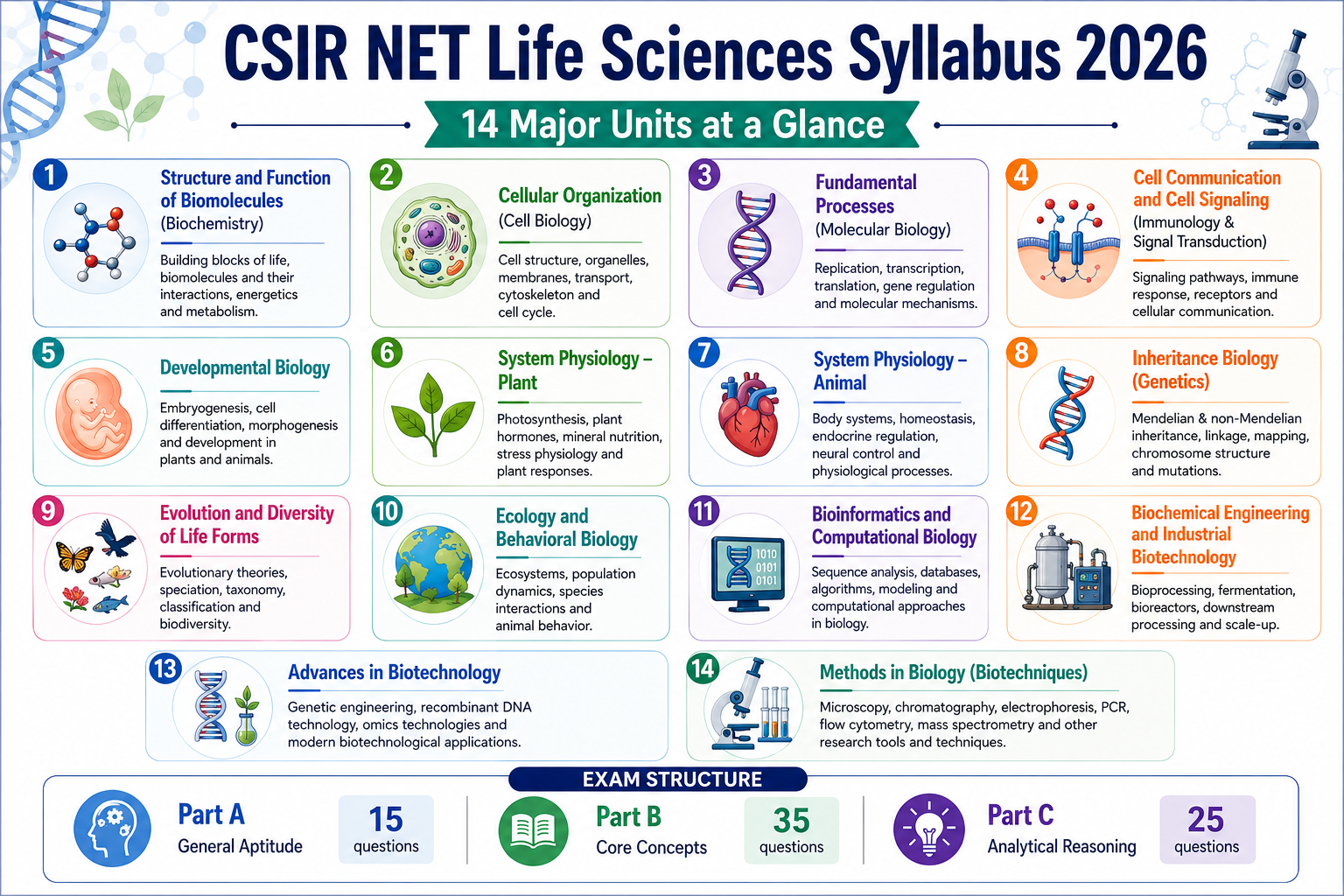
The CSIR NET Life Sciences Syllabus 2026 comprises 14 comprehensive units spanning molecular biology, genetics, physiology, ecology, bioinformatics, and advanced biotechnology. The examination features a three-part structure—Part A (General Aptitude), Part B (Core Knowledge), and Part C (Scientific Reasoning)—designed to evaluate foundational concepts and advanced experimental problem-solving skills across all 14 units.
What Is the Structure of the CSIR NET Life Sciences Examination?
Before diving into the complex topics, you need a clear picture of how the question paper is actually put together. The CSIR NET Life Sciences exam is a single three-hour computer-based test containing 145 multiple-choice questions (MCQs). However, you don’t have to answer all of them; you select a total of 75 questions to solve.
The paper is split into three specific parts, each serving a different purpose:
- Part A (General Aptitude): This section contains 20 questions that test your mathematical reasoning, ability to analyze graphs, logical deductions, and general research aptitude. You need to answer any 15 questions. Every correct response gives you 2 marks, while a wrong one takes away 0.5 marks.
- Part B (Core Knowledge): Here you will find 50 direct, memory-based and conceptual MCQs that come straight from the graduate and postgraduate Life Sciences curriculum. You choose any 35 questions to answer. Correct answers score 2 marks, and wrong answers carry a 0.5-mark penalty.
- Part C (Scientific Reasoning): This is the most challenging section, featuring 75 detailed, multi-statement, or data-heavy questions designed to test your experimental analytical skills. You only need to pick 25 questions. Because these are tougher, correct answers give you 4 marks, but an incorrect guess will cost you a full 1 mark.
| Examination Section | Total Available Questions | Maximum Questions to Attempt | Marks per Correct Answer | Negative Marking per Wrong Answer |
| Part A | 20 | 15 | 2 | 0.5 |
| Part B | 50 | 35 | 2 | 0.5 |
| Part C | 75 | 25 | 4 | 1.0 |
| Total | 145 | 75 | 200 Marks | — |
What Are the Major Units Covered in the CSIR NET Life Sciences Syllabus 2026?
The updated syllabus is organized into 14 broad units. They move systematically from micro-level biochemical interactions up to large-scale global ecosystems, computing, and industrial engineering:
- Structure and Function of Biomolecules (Biochemistry)
- Cellular Organization (Cell Biology)
- Fundamental Processes (Molecular Biology)
- Cell Communication and Cell Signaling (Immunology & Signal Transduction)
- Developmental Biology
- System Physiology – Plant
- System Physiology – Animal
- Inheritance Biology (Genetics)
- Evolution and Diversity of Life Forms
- Ecology and Behavioral Biology
- Bioinformatics and Computational Biology
- Biochemical Engineering and Industrial Biotechnology
- Advances in Biotechnology
- Methods in Biology (Biotechniques)
What Topics Are Included in the Structure and Function of Biomolecules?
Unit 1 provides the foundational chemistry needed to make sense of biological systems. It focuses heavily on the thermodynamic laws and molecular structures that drive cellular reactions.
Make sure you spend enough time on these key areas:
- Structure of Atoms and Molecules: The nature of covalent, ionic, and hydrogen bonds, van der Waals interactions, and why the physical properties of water are so critical to life.
- Bioenergetics: Laws of thermodynamics, how cells couple reactions, free energy changes, entropy, and the mechanics of oxidative phosphorylation.
- Protein Chemistry: Amino acid behaviors, peptide bond traits, reading Ramachandran plots, and the rules governing primary, secondary, tertiary, and quaternary protein folding.
- Enzyme Kinetics: Deriving and interpreting Michaelis-Menten equations, building Lineweaver-Burk plots, identifying types of enzyme inhibition, and allosteric control.
- Metabolic Pathways: Step-by-step molecular adjustments in glycolysis, the citric acid cycle (Krebs), glycogen production, fatty acid breakdown, and nucleotide pathways.
What Should Students Study Under Cellular Organization and Fundamental Processes?
Units 2 and 3 focus on cell biology and molecular biology. These two subjects are closely linked, and Part C often combines them into single, complex questions.
Cellular Organization (Unit 2)
This unit looks closely at how cells are built and how they move materials around inside themselves:
- Membrane Structure & Function: Testing the fluid-mosaic model, how lipid rafts behave, maintaining membrane asymmetry, active vs. passive transport, ion channels, and membrane potentials.
- Structural Organelles: The internal architecture and roles of the nucleus, mitochondria, chloroplasts, Golgi apparatus, and endoplasmic reticulum.
- Cytoskeleton Dynamics: How microtubules, microfilaments, and intermediate filaments assemble and disassemble to allow cell movement and internal transport.
- Cell Cycle & Mitosis: The precise control systems involving cyclins and cyclin-dependent kinases (CDKs), checking for DNA damage at cell cycle checkpoints, and spindle fiber attachment.
Fundamental Processes (Unit 3)
This area gets into the core mechanics of molecular genetics:
- DNA Replication: Understanding replication forks, handling proofreading enzymes, managing telomeres, and fixing mutations through DNA repair pathways in prokaryotes and eukaryotes.
- RNA Synthesis: How transcription factors find promoters and enhancers, the roles of different RNA polymerases, and post-transcriptional processing like splicing, capping, and tailing.
- Protein Translation: Decoding the genetic code, setting up translation initiation complexes, elongation steps, termination factors, and subsequent post-translational changes.
- Gene Regulation: How the Lac, Trp, and Ara operons control bacterial systems, alongside chromatin remodeling and gene silencing mechanisms in higher organisms.
Which Genetics and Evolution Concepts Are Frequently Asked in CSIR NET?
Genetics (Unit 8) and Evolution (Unit 9) blend mathematical problem-solving with the study of long-term biological adaptation.
Inheritance Biology (Unit 8)
- Mendelian Principles: Clear comprehension of dominance, segregation ratios, and independent assortment.
- Extensions of Mendelian Rules: Solving problems on codominance, incomplete dominance, lethal alleles, epistasis, pleiotropy, and genomic imprinting.
- Gene Mapping Methods: Constructing linkage maps, calculating recombination frequencies from three-point test crosses, tetrad analysis, and using somatic cell hybridization.
- Chromosomal Alterations: Real-world impacts of deletions, duplications, inversions, translocations, and shifts in ploidy levels.
Evolution and Diversity of Life Forms (Unit 9)
- History of Evolutionary Thought: Comparing Lamarckism and Darwinism with the insights of modern evolutionary synthesis.
- Population Genetics: Working with the Hardy-Weinberg equilibrium, calculating allele frequencies, understanding genetic drift, and evaluating selection pressures.
- Speciation: The pathways of allopatric, sympatric, and parapatric speciation, reproductive isolation barriers, and reading phylogenetic trees.
- Behavioral Ecology: The mechanics of altruism, kin selection, biological clocks, and diverse mating strategies.
What Areas of System Physiology Are Most Important for Life Sciences Aspirants?
System Physiology requires an integrated understanding of how organs work together to maintain a stable internal environment.
Animal Physiology (Unit 7)
- Cardiovascular System: Analyzing the cardiac cycle, reading ECG wave variations, neural regulation of blood pressure, and volume control.
- Respiratory System: The physics of gas exchange, understanding hemoglobin-oxygen dissociation curves, and metabolic pH buffering.
- Excretory System: How nephrons concentrate waste, running the countercurrent multiplier system, and hormonal control of fluid balance.
- Nervous System: Mechanics of resting potentials, action potential propagation, synaptic transmission, and neurotransmitter function.
- Endocrine System: Hormone synthesis, receptor signaling, hypothalamic-pituitary regulation, feedback mechanisms, and endocrine disorders.
Which Plant Sciences Topics Are Included in the 2026 Syllabus?
Plant Physiology (Unit 6) focuses on photosynthesis, respiration, mineral nutrition, plant growth regulators, stress physiology, and environmental responses. Understanding how these processes interact is essential for solving analytical questions in Part C.
- Photosynthesis: How light-harvesting complexes process energy, non-photochemical quenching, the oxygen-evolving complex, and comparing C3, C4, and CAM pathways.
- Phytohormones: Tracking the synthesis, movement, and complex signaling networks of Auxins, Gibberellins, Cytokinins, Abscisic acid, and Ethylene.
- Nitrogen Metabolism: How root nodules form, biochemical nitrogen fixation, and the pathways for nitrate and ammonium assimilation.
- Sensory Photobiology: The activation mechanisms of phytochromes, cryptochromes, and phototropins, and how they dictate photoperiodism and flowering times.
What Should Candidates Prepare in Ecology, Bioinformatics, and Industrial Biotechnology?
Units 10, 11, 12, and 13 expand directly into macro-level ecosystems, computational tools, and core biotechnology applications.
Ecology and Behavioral Biology (Unit 10)
- The Environment: Analyzing physical environments, how biotic and abiotic factors cross paths, and identifying limiting resources.
- Habitat and Niche: Differentiating between a fundamental and realized niche, resource partitioning, and character displacement.
- Population Ecology: Understanding r- and K-selection strategies, age structure analysis, survivorship curves, life tables, and population growth models.
Bioinformatics and Computational Biology (Unit 11)
- Sequence Analysis: Working with alignment algorithms (BLAST, FASTA), scoring matrices, and phylogenetic software.
- Structural Bioinformatics: Protein structure prediction tools, molecular modeling, and database exploration (PDB, NCBI, UniProt).
Biochemical Engineering, Industrial Biotechnology & Advances (Units 12 & 13)
- Fermentation Systems: Bioreactor design, media optimization, kinetics of microbial growth, batch/continuous cultures, and downstream processing.
- Genetic Engineering Advances: CRISPR-Cas9 mechanics, metabolic engineering, vaccine technology, and synthetic biology applications.
Which Units Usually Carry Higher Weightage in CSIR NET Life Sciences?
While the examiners draw questions from every part of the syllabus, data from past question papers shows that a handful of core units carry a disproportionate amount of weight—especially when it comes to the high-scoring Part C.
- Fundamental Processes (Unit 3): This unit is a goldmine for Part C, frequently featuring multi-step experimental questions about transcriptional regulation and RNA processing.
- Cell Communication & Signaling (Unit 4): Questions on how pathogens breach cell walls, the pathways of apoptosis, cancer mutations, and GPCR cascades show up year after year.
- Biochemistry (Unit 1): You can safely expect practical calculations involving thermodynamics, enzyme mutations, and structural evaluations using Ramachandran parameters.
- Inheritance Biology (Unit 8): This unit consistently delivers analytical puzzles based on pedigree charts, genetic crosses, and bacterial gene mapping.
- Methods in Biology (Unit 14): This final unit tests your understanding of the lab tools used in modern research, focusing on NMR, mass spectrometry, FACS analysis, and gene cloning protocols.
How Can Students Cover the Entire CSIR NET Life Sciences Syllabus Effectively?
Getting through an expansive 14-unit syllabus like this requires a smart plan, a realistic calendar, and regular self-assessment. Because the questions are highly integrated, trying to memorize everything by heart rarely works for Part C. You need to understand the logic behind experimental setups, biochemical mechanisms, and mathematical relationships.
Working with high-quality textbooks, resolving confusing concepts early, and breaking down old exam papers can make your preparation much smoother. For many students, having an outside structure helps keep them consistent and accountable. Signing up for professional csir net life science coaching is a practical way to organize your study schedule, clarify difficult topics, and gain access to targeted practice questions.
A high-quality learning program provides reliable study materials and practice exams modeled after the actual computer-based test. If you are trying to balance preparation with university classes or a job, choosing a flexible csir net life science online coaching program lets you attend live sessions and review recorded lectures whenever your schedule allows.
Why Do Many Aspirants Choose Biotech Sapiens for CSIR NET Preparation?
Biotech Sapiens focuses on giving students a clear, systematic way to prepare for demanding competitive exams like CSIR-UGC NET, GATE, and DBT-JRF. Led by a team of experienced instructors who have qualified the CSIR-UGC NET and GATE exams themselves, the institute works to build genuine conceptual clarity across all 14 units of the updated syllabus.
The institute relies on a few core principles to support its students:
- Personal Support: We maintain small batch sizes so instructors can provide personalized guidance and address individual doubts effectively.
- Regular Practice: Weekly practice tests and performance reviews help students understand their weak areas, perfect their time management, and get fully comfortable with the online test format.
- Flexible Classroom Formats: Students can opt for traditional in-person classes or enroll in our structured csir net life science online coaching platform to keep their studies on track from anywhere.
- Long-Term Assistance: Biotech Sapiens offers a lifetime support policy, meaning you can continue attending classes and using our study resources until you successfully clear your exam.
This practical approach to teaching has helped many of our students earn research fellowships and secure seats at top-tier institutions, including IISc Bangalore, TIFR, PGIMER, IMTECH, IISER, NABI, IITs, JNU, and BHU. Finding reliable guidance through an established csir net life science coaching center can help streamline your daily study habits and eliminate the guesswork from your preparation.
Frequently Asked Questions (FAQs)
Is the CSIR NET Life Sciences syllabus changing in 2026?
Yes, the curriculum framework has transitioned into a 14-unit structure to comprehensively cover both Core Life Sciences and Applied Biotechnology.
How many units are there in the Life Sciences syllabus now?
The newly updated syllabus is organized into exactly 14 units, introducing dedicated spaces for bioinformatics, computational biology, and biochemical engineering.
Which unit has the highest weightage?
Units 1, 2, 3, 8, and 14 generally yield the highest number of questions, especially the heavy 4-mark analytical problems in Part C.
Is the syllabus the same for online and offline preparation?
Yes, the syllabus is completely identical. Comprehensive csir net life science online coaching covers the exact same topics, notes, and full-length test series as the physical classroom courses.
Can I prepare through csir net life science online coaching?
Absolutely. Modern online preparation platforms provide interactive live sessions, access to lecture archives, digital study materials, and mock exams that match the actual test interface, making it a great option if you need flexibility.
How does csir net life science coaching help improve scores?
Joining a dedicated csir net life science coaching institute gives you a structured path through the massive 14-unit syllabus, saves you time on finding study materials, and teaches you the specific problem-solving strategies needed for Part C.
Conclusion
Working with an established institute like Biotech Sapiens provides the study resources, practice exams, and expert faculty advice needed to build absolute confidence. With a clear plan, steady practice, and a systematic approach, you can successfully reach your academic goals and launch your research career.
Contact Information
- Address: SCO 215 Sector 37-C, 2nd Floor, Chandigarh
- Phone: +91-7696980531 | +91-9915314779
- Email: biotechsapiens29@gmail.com